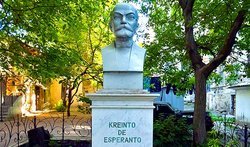
Pamiatnyk sozdateliu Esperanto Liudvyku Zamenhofu - Odesa, vnutrishnii dvoryk na vul. Derybasivska, 3
Pamiatnyk sozdateliu Esperanto Liudvyku Zamenhofu: how do i get there and where it is placed, how it works (what time it opens and when it closes), address, phone number, entrance ticket price, official website, reviews of employees and tourists, photos and videos, description of the attraction, routes, location on the map
Address:
Odesa, vnutrishnii dvoryk na vul. Derybasivska, 3
Schedule:
00:00-24:00
Cost / price:
0 hrn
Route / how do i get there:
You can get here by many minibuses, in particular, No. 10, 110, 120, 155, 190, 210, 233, stop "Polish Spusk", or through Grecheskaya Street by routes No. 137 and 145, stop "Greek Street".
Description of the sight
In a cozy and small courtyard of Odessa, on the famous Deribasovskaya street, there is a bust of Lazar Ludwik Zamenhof, the creator of the international language Esperanto. Why exactly in Odessa? It is believed that Odessans were among the first thousand who began to study and speak this language. In addition, a circle of Esperantists constantly worked in the city. Like most sightseeing Odessa, this monument is covered with legends. Local residents claim that the creator of the artificial language lived in this courtyard, according to another version - the creator, after an unpaid bill, had to invent a "legend" about his father Zamenhof and place his creation opposite his own apartment. In fact, the monument was erected in 1959 by Nikolai Vasilievich Blazhkov, a sculptor and leader of the Esperanto circle in Odessa. On the occasion of the arrival of a delegation of Esperantists from the sister city of Varna, one copy of the bust of Lazarus by Ludwik Zamenhof was presented, and the creator installed the second bust in his yard. He really lived on Deribasovskaya. At present, after the restoration work carried out in 2008, the monument has become an integral part of the historical and cultural heritage of the city. Like Esperanto, it brings together extraordinary people who are capable of expanding language boundaries. According to experts, Esperanto is spoken by 2 to 20 million people in different parts of the world, and about 1,000 people in Odessa.
Location on the map
Video about the sight
All sights of the city
2
1
1
1
2
1